
Case Studies6 min readJuly 15, 2026

Decathlon 'Deal Frenzy / Cơn Lốc Deal': A Shareable WebAR Face-Filter Game

Decathlon Vietnam asked for a viral TikTok/Instagram AR filter game. But Meta killed third-party AR filters in 2025. Here's how Code Crush delivered the same face-tracking, group-bonus catch game as a shareable WebAR experience — built with MediaPipe, no app and no platform gatekeeper.

Code Crush Team

Gamification Agency

Decathlon Deal Frenzy Cơn Lốc Deal — a shareable WebAR face-filter catch game

The Project

Deal Frenzy — Cơn Lốc Deal ("Deal Cyclone") is the second of two gamification concepts Code Crush prototyped for Decathlon Vietnam. Where the Deal-cathlon AR Hunt drives people into stores, this one is built to spread online: a fast, funny, face-controlled catch game you play with your camera and share with friends.

The Decathlon tower bursts open, gear rains down, and you move your head to sweep a basket left and right catching it — in 50 seconds — while dodging storm clouds. Everyone who plays wins something.
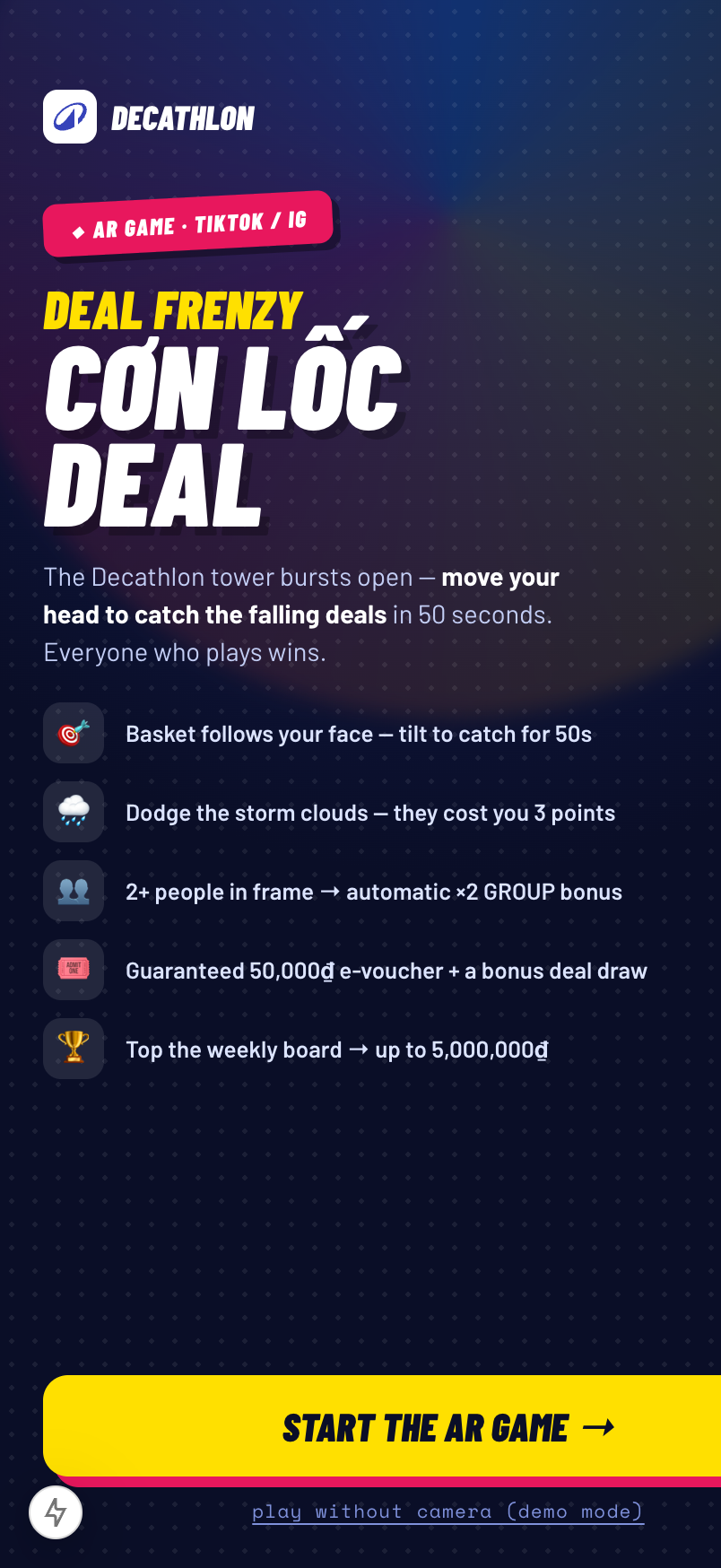
The Deal Frenzy intro. Face-controlled basket, a ×2 group bonus, a guaranteed voucher, and a weekly leaderboard worth up to 5,000,000₫.

The Brief

The pitch deck was specific about the goal — and about the channel:

A fun, shareable AR filter game on TikTok and Instagram. Use face/hand tracking to catch falling Decathlon gear. Design it so playing with friends or family triggers a group bonus, and give everyone a guaranteed reward with a leaderboard on top.

So the requested mechanics were clear: face/hand tracking, a 50-second catch round, a ×2 group bonus when two or more people are in frame, a guaranteed 50K e-voucher, and a weekly/seasonal leaderboard.

The Catch: The Brief Asked for a Platform That No Longer Exists

Here's the honest problem we hit, and how we solved it.

You can no longer publish a custom AR filter to Instagram or Facebook. Meta shut down Spark AR — its third-party AR filter platform — on 14 January 2025. Brands and agencies can't ship custom Meta filters anymore. TikTok's Effect House still exists, but it's a closed, proprietary editor: you build inside their tool, on their terms, and you can't embed your own logic, rewards, CRM, or fraud checks.

Building the brief literally would mean either shipping to a dead platform or handcuffing the whole reward-and-data layer to someone else's sandbox.

How Code Crush Answered It

We delivered the exact same experience as WebAR — a face-tracking AR game that runs in the mobile browser and is shared by link or QR.

That decision turned the platform limitation into an advantage:
It runs everywhere — one link works on TikTok's in-app browser, Instagram, Zalo, Messenger, or a QR on a poster. No "available on iOS only."
We own the whole loop — scoring, the guaranteed voucher, the leaderboard, sharing, and first-party data capture all live in our code, not a platform's effect sandbox.
No app, no gatekeeper, no review queue — publish and iterate the moment we want to.
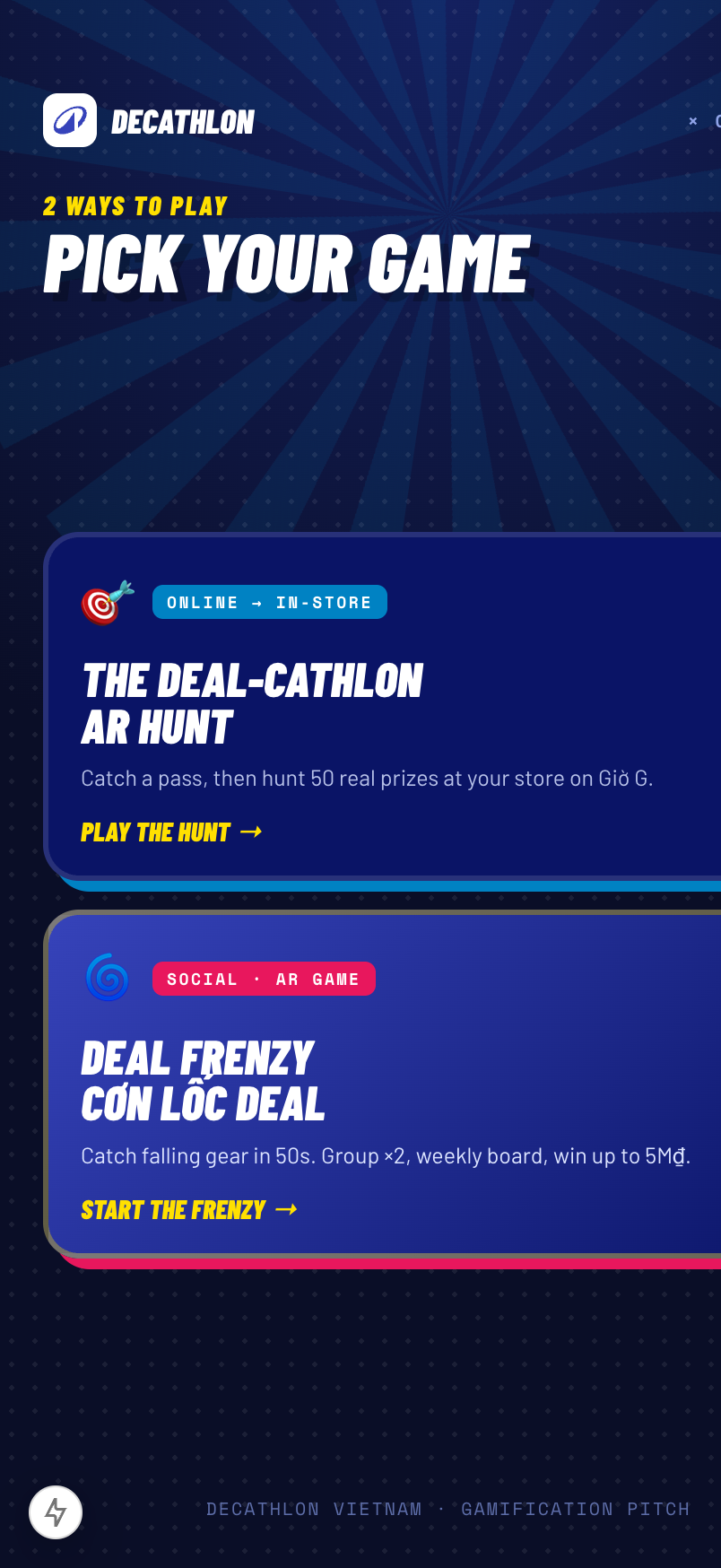
Both concepts live behind one link — players pick "The Deal-cathlon AR Hunt" or "Deal Frenzy / Cơn Lốc Deal" from the hub.

How We Coded It

Face tracking: Google's MediaPipe FaceLandmarker (Tasks Vision). We self-host the WASM runtime and the model file and lazy-load them only when the game starts, so they stay out of the first-load bundle and the landing screen stays instant.
Head-pinned basket: the catch basket follows the player's detected face position — tilt your head and the basket sweeps to meet the falling gear. It's the same primitive as a virtual try-on, so players instantly understand "my face is the controller."
The ×2 group bonus: the tracker counts faces in frame. When it sees two or more people continuously, the round's score doubles automatically — the mechanic that literally rewards pulling a friend into the shot.
Risk, not just reward: roughly one in six drops is a storm cloud worth −3 points, so the round needs attention rather than blind sweeping. Score milestones fire along the way for feel.
Rewards: a guaranteed 50,000₫ e-voucher for finishing, plus a weighted bonus draw, and a weekly + seasonal leaderboard the player is slotted into by score.
Real sharing: a generated score card plus the Web Share API, so "share your run" is a native share sheet, not a dead button.
Graceful fallback: no camera, or a device that can't run the model? The basket switches to finger-drag with a manual group-bonus toggle, so nobody is locked out.

The Limits (and the honest trade-offs)

No native platform filter — by necessity. As above, custom Meta filters are gone and Effect House is closed. WebAR is the only route that keeps the rewards and data first-party. The trade is that it lives in the browser rather than inside the TikTok/IG effect camera.
Face tracking is device-dependent. On-device ML needs a reasonably modern phone and camera permission; performance varies, which is exactly why the finger-drag fallback exists.
The leaderboard needs a backend to be real. In the prototype it's seeded client-side. A live campaign needs a server, plus the identity and anti-fraud checks the brief calls for (leaderboard-attempt caps, dedupe) before real prize money is on the line.
Camera permission is a funnel step. Some players won't grant it — the guaranteed voucher and the fallback mode are there to keep those players in the game.

Why It Works for Decathlon

The group bonus is the growth engine: the cheapest way to double your score is to pull someone into frame, so the game spreads itself. Everyone wins a voucher, so every play is a redeemable reason to visit Decathlon — and because it's our code, every play is also first-party data for remarketing.

This is one of two concepts from the pitch. Its sibling — the in-store camera treasure hunt — is written up in Decathlon "Deal-cathlon AR Hunt": An In-Store WebAR Treasure Hunt.

Prototype designed and built by Code Crush as a concept for Decathlon Vietnam. Rewards, leaderboard, and timing are illustrative. Spark AR shutdown date per Meta's public announcement.

Tagged with

case studyDecathlonWebARAR face trackingMediaPipesocial gameSpark ARviral marketingVietnam
Free Newsletter

Get Gamification Insights Delivered Weekly

Join brand managers and marketers getting our best content on branded games, engagement strategies, and interactive marketing — no spam, unsubscribe anytime.

No spam. Unsubscribe anytime. We respect your inbox.

Let's Build Something Your Audience Will Love

From branded games to immersive 3D experiences — we bring engagement to life.