

The brief: let people play and become contacts
A branded game campaign can be asked to do two jobs: create a memorable interaction and bring usable enquiries into a CRM. The question is not just whether the game can run on a phone. It is where the interaction takes place, what the advertising platform supports, and when a person actually agrees to share contact details.
Pickleball Breaker, which Code Crush built for Sportkation, is a useful example. The browser game already exists. A campaign can use its real gameplay and send visitors to the web experience. But that does not make a Facebook playable ad interchangeable with a website ad or a Lead Ad.
This guide sets out a proposed campaign architecture, not a report of a launched lead campaign. The platform rules were checked on 2 November 2026. There are no campaign performance results to claim here. The existing product is documented in our Pickleball Breaker case study.
Three formats that should not be confused
A native Meta playable is an interactive preview associated with app promotion. A website game campaign sends the person to a game after the ad click. A Lead Ad with an Instant Form collects a submitted lead within Meta before offering a website link.
The same video footage can introduce all three. The supported destination and contact capture mechanism are different.
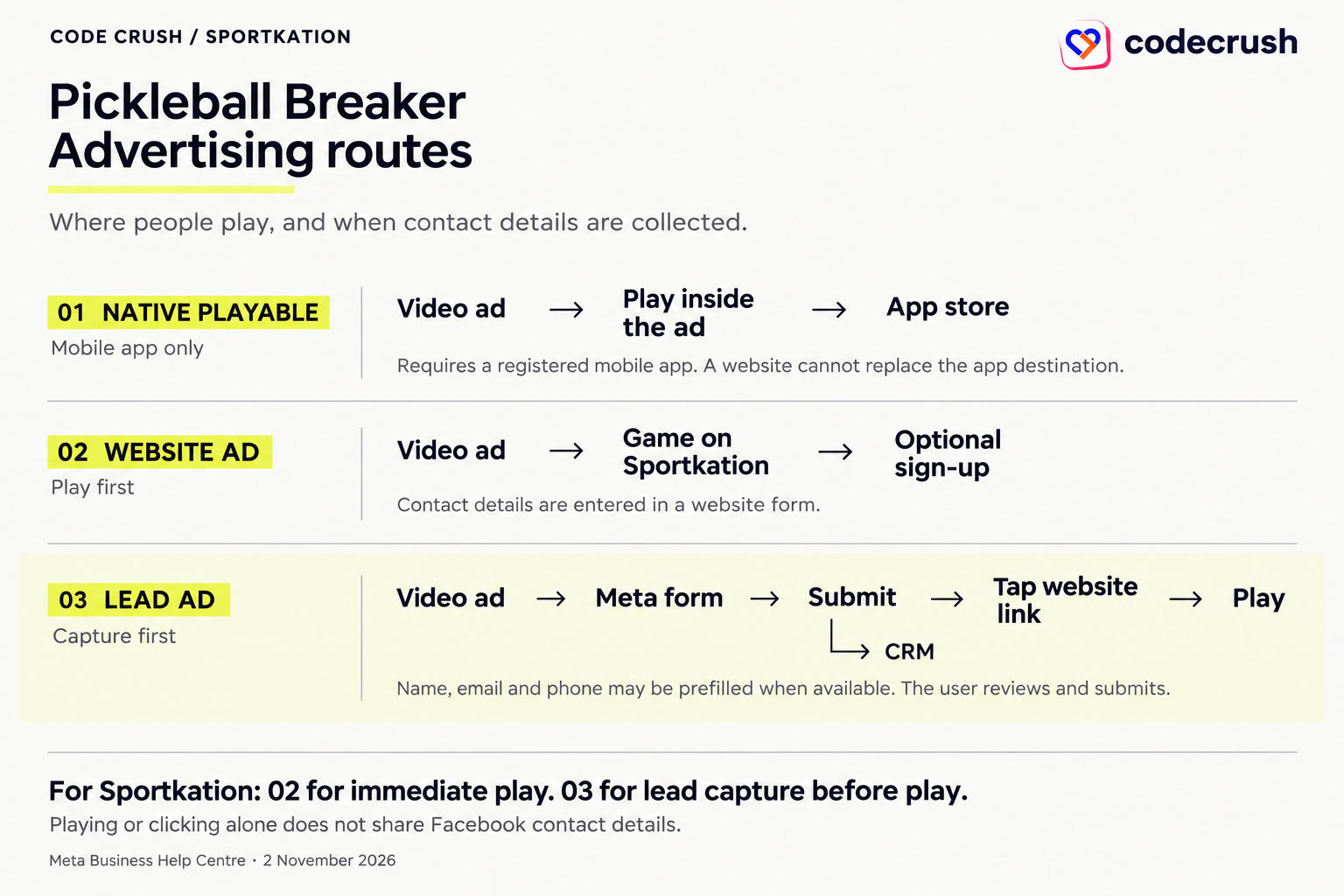
Case 1: native playables require a mobile app destination
Meta's current playable upload instructions require App promotion and selection of a registered app by name or exact store URL. The instructions exclude other objectives and describe errors if no app is selected or the advertiser lacks permission. The developer integration guide also uses an application ID and an app-store URL.
For a website-only project, a browser URL cannot simply take the place of that mobile app destination. A playable file passing a technical preview is not proof that a website campaign can serve the format. Likewise, a campaign destination field that supports URLs in another context does not establish support for native playables.
The playable CTA uses the Meta-provided integration. It should not be replaced with a JavaScript redirect to bypass the campaign destination. The brief should first establish that there is a real mobile app to promote, and only then justify production of an app-install playable.
For the current Sportkation website brief, this is not the supported distribution route.
Case 2: a play-first website campaign
The simplest way to let people experience a browser game is a website ad that links to it. A short image or video creative shows the actual interaction, makes the next action clear and sends the visitor to a page designed for immediate play.
For Pickleball Breaker, that means a recognisable court, an understandable paddle movement and a quick first serve. A short introductory objective can be created for the campaign, but it should be described as a design proposal until implemented and should remain representative of the actual game.
The sequence is:
This route gives the game the first opportunity to earn attention. It also allows people to play without becoming leads. That is an intentional trade-off, not necessarily a failed conversion.
A website form collects the details entered and submitted there. The visitor being signed into Facebook does not give the page automatic access to a Facebook email address, phone number or profile. A Pixel and campaign tags do not supply those contact details either.
Case 3: a Lead Ad that captures first, then opens the game
When the client specifically wants supported contact fields that Meta may already hold, a Lead Ad with a Meta Instant Form is the relevant starting point. Meta's lead generation setup guide distinguishes Instant Forms from website forms and describes retrieving submitted leads through a CRM connection.
This route puts capture before gameplay:
The website button is a separate action. Form submission should not be described as an automatic redirect or as a completed game session. A person may submit and decide not to continue.
In parallel, the submitted lead can be retrieved by an authorised CRM integration. CRM delivery is not dependent on the person starting a match, and starting a match is not proof of a successful CRM handoff.
A Lead Ad is not a native playable with a contact form attached. The game in this route runs on the website.
Make the form worth opening
The ad's promise should remain true when the next screen appears. "Leave your details, then try Pickleball Breaker" describes the sequence. "Play instantly in this ad" would be misleading if the next action is a lead form.
Start with the minimum contact fields the follow-up actually requires. Name and email may be enough for an initial interest request. Add a phone field when a callback is part of the stated purpose. Prefill reduces typing, but a prefilled value may be old or edited; it is not a guarantee of a verified contact channel.
The form introduction should answer four questions: who receives the information, why it is being requested, what follow-up to expect, and how to reach the privacy information. Avoid bundling an unexplained newsletter subscription into an otherwise narrow request. Define any additional marketing permission separately and implement the notices appropriate to the audience and purpose.
A brief interest question can help route enquiries, for example beginner coaching, an existing player's training needs or a group experience. These are suggestions for campaign design, not requirements already imposed on Sportkation visitors.
Design the completion screen as part of the product
The completion screen is often treated as an administrative ending. In a lead-to-game campaign, it is a conversion point of its own.
Use a short confirmation such as "Your details have been sent. Visit Sportkation to play Pickleball Breaker." Configure the available website action with the game's destination, then preview the actual label and behaviour in the selected form setup. The landing page should repeat the game name and the visual cues from the ad.
Avoid asking for the same details again immediately after the person clicks through. If the game later needs an authenticated account to save a score, explain that separate purpose at the right moment instead of pretending the lead form created an account.
Campaign tags can identify visits from the completion screen. They should describe a campaign or creative, not contain a person's name, email or phone. A generic tagged URL does not establish which lead played.
Specify the CRM integration before production
The CRM connection belongs in the campaign specification, alongside the visual creative and landing page. A launch is incomplete if people can submit but no one can find or handle the resulting enquiries.
The data contract should identify:
Repeated delivery of the same platform lead should not create duplicate CRM contacts. A scheduled reconciliation or equivalent recovery process should compare expected submissions and completed deliveries. Design for the case where the first notification is delayed or a connector loses access.
Keep lead retrieval separate from advertising optimisation. Sending later outcomes back to Meta is another integration decision; it does not happen merely because a CRM can download submitted forms. Do not promise conversion optimisation before the required setup and validation exist.
Separate lead identity from game identity
An Instant Form submission does not automatically authenticate a website user. A completion-screen link is a navigation action. Neither proves that an anonymous browser session belongs to a specific lead.
If the brief needs a saved score, a personalised experience or an association with a verified account, specify that as another product feature. An explained verification or authenticated handoff can be designed; placing raw personal information in a public URL is not an appropriate shortcut.
For the first pilot, aggregate reporting is often sufficient. Count the form submission, CRM delivery, tagged game arrival and first serve separately. The difference between these counts is useful. It reveals where people stop without claiming a perfect person-level join.
Facebook Login is also a separate integration. It has its own permissions and technical requirements. Adding a Lead Ad, Pixel or playable does not activate it, and a login flow should not be sold as unrestricted profile access.
Produce the website game for feed traffic
An existing web game may need a campaign-specific entry experience. That does not necessarily mean rewriting its engine. It means delivering an understandable first interaction to the phones and browsers used by the audience.
Budget what loads before the first serve. The initial court and equipment may be enough; optional environments and nonessential panels can follow later. Give the player a visible loading state rather than an unexplained blank screen. Keep touch targets large enough, provide a clear serve action and support a useful silent experience.
A website game is not subject to the native playable package's file-size rules, but mobile connection speed and rendering cost still matter. Test the actual campaign destination on representative iOS and Android phones, including Facebook and Instagram's in-app browsers. Check audio activation, background and resume, orientation and repeat visits.
Do not use a desktop test as proof that the whole journey works on mobile. The exact link, campaign parameters, redirects, landing page and game should be tested together.
Use metrics that describe the actual objective
A low cost per click does not show that a game was played. A low cost per submitted form does not show that the contact wanted a conversation. Each campaign should have a primary outcome and a small set of supporting indicators.
Useful ratios include first serves divided by measured arrivals, or successfully delivered unique leads divided by submitted leads over a comparable time window. A qualification rate needs an explicit definition and enough time for the team to handle the enquiry.
Some comparisons are only directional. Website game starts divided by all Meta submissions is not a verified person-level completion rate. Browser permissions, repeated visits, platform attribution and people who submit without continuing can all affect the comparison. State what a metric can establish before attaching a performance claim to it.
A production plan the client can review
The first reviewable deliverable should be the whole journey, not only the game screen. Our proposed plan for this kind of brief has six parts:
For a lead-first Sportkation pilot, that means a real gameplay creative, an Instant Form, a completion-screen website button, the game destination, an authorised CRM connection and a reporting view that keeps capture separate from play. These are proposed implementation deliverables. Publishing this article does not activate a campaign or imply that these integrations are complete.
Validate both the visitor journey and the team workflow
A useful acceptance test follows a clearly labelled test lead from the ad preview through the form and into the correct CRM workspace. It then checks the separate completion-screen click and first match.
Correct a prefilled field before submission. Inspect the resulting CRM record. Confirm that repeated delivery does not create a duplicate. Open the destination on an actual phone and verify the first playable interaction, not just a screenshot of the court.
Also check broken or slow loading, an interrupted session, privacy links, opt-out handling for any follow-up, campaign tags and personal data in logs. Confirm that errors have an owner. A creative review cannot substitute for an integration review, and a successful CRM import cannot substitute for a playable mobile journey.
Any competition, prize or stay-related offer needs its own real terms and operational readiness. The game should not imply that a score wins something simply because a campaign needs an incentive.
The recommendation for a website-only brand game
For immediate interaction, use a website destination and earn attention through the game before inviting an optional submission. For contact capture using available Meta-prefilled fields, use a Lead Ad and Instant Form first, then a completion-screen link to the website game.
Keep native Meta playables for briefs with an eligible mobile app destination. That distinction lets the production team focus effort on an experience that can be distributed as promised.
Read the Sportkation guide to the player journey, try Pickleball Breaker, or talk to Code Crush about a branded game campaign.
Official sources
The platform requirements in this article were checked on 2 November 2026. Review the current instructions and account settings before launch.
Meta Business Help Centre: upload a playable source file
Frequently Asked Questions
- Can a native Meta playable use a website instead of a mobile app destination?
- The documented native playable setup requires App promotion and a registered mobile app destination. For a website-only project, use a website ad or a Lead Ad with a completion-screen link to the browser game.
- Does playing a game in an ad share Facebook contact details?
- No. Playing, viewing or clicking an ad does not automatically share a person’s Facebook contact information. A business receives the details a person submits through the chosen capture flow.
- How does a Lead Ad connect to a browser game?
- The person opens the Meta Instant Form, reviews and submits their details, then chooses the website button on the completion screen. The game opens on the website after that separate click.
- Are name, email and phone always available?
- No. Supported fields may be prefilled when Meta has information available, and the person can review or edit it. A prefilled field does not guarantee a current or verified contact channel.
- Does an Instant Form create a game account or save a score?
- No. Contact capture, game authentication and score saving are distinct features. Connecting them requires an explained and validated identity flow.
Tagged with


