
Most brand mascots have a sad little life. They are born in an illustrator's file, they get three approved poses in a brand book, and then they spend the rest of their career standing in the corner of a banner, waving at nobody.
Which is a waste, because a mascot is the one asset in your brand kit that people are willing to have a relationship with.
This is Miraito. Toyota Vietnam's Million Green Miles campaign gave us the character as flat reference art, and we rebuilt it as a 3D character that walks, waves, celebrates, points, blinks on its own and can be dropped into a game, a landing page or an AR filter.
Here it is. Spin it, change the animation, drag the expression sliders, and — this is the fun one — tick the skeleton box and watch the rig underneath.
Go and press things. I'll explain what you broke afterwards.
A Mascot That Cannot Move Cannot Host Anything
The gap between "we have a mascot" and "our mascot can do things" is enormous, and it is almost entirely a production gap.
Flat art gets you a sticker. A rigged 3D character gets you a host — something that can greet a player at the start of a game, react when they win, point at the thing you need them to tap, stand on a product page and turn to face the cursor, or appear in a hundred marketing renders next week without booking an illustrator.
Same character. Completely different asset class.
First You Work Out What the Character Actually Is
Before any modelling, somebody has to decide which parts of a drawing are the character and which parts are just how it was drawn that day.
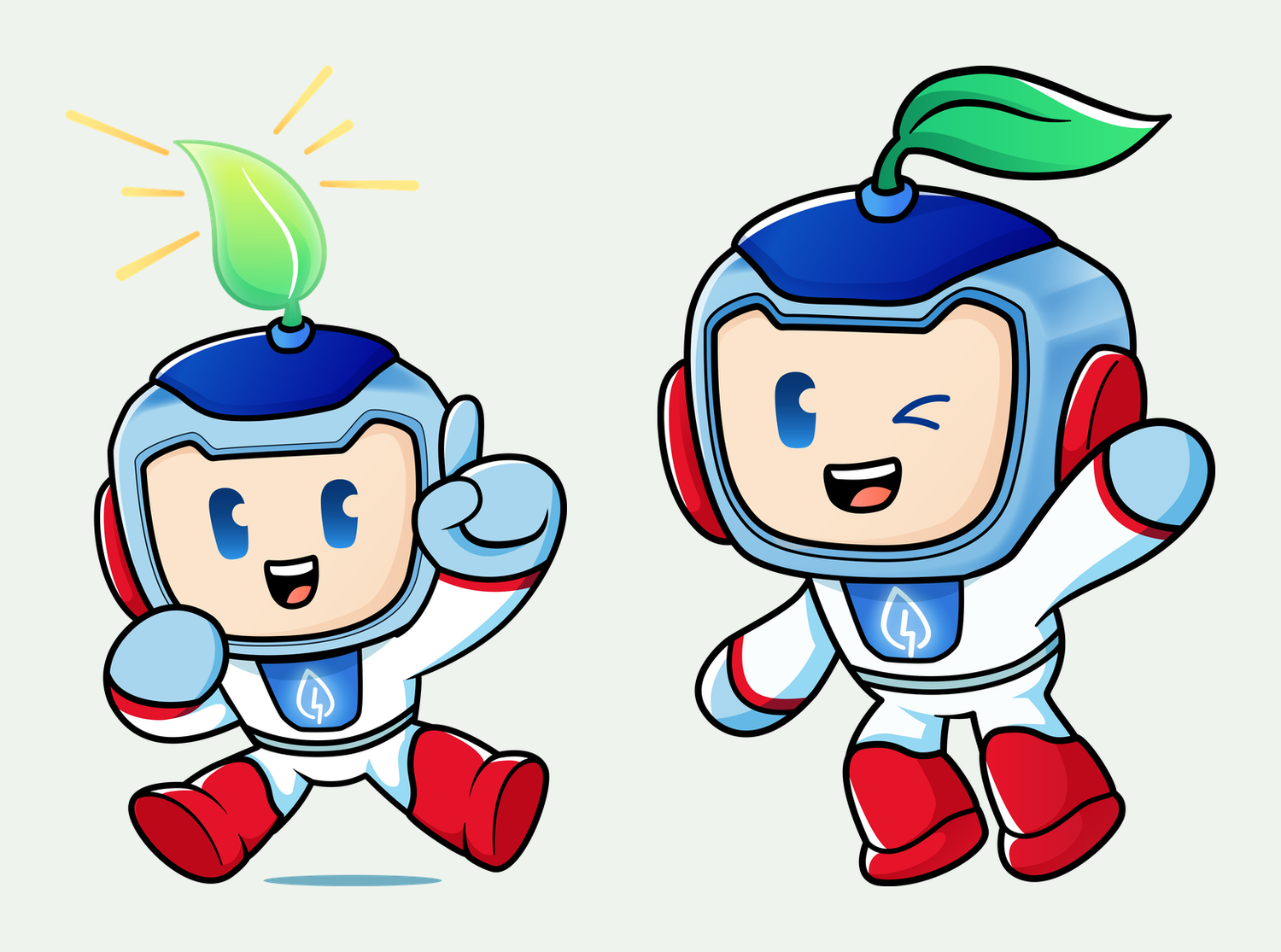
Two illustrations. That is the whole brief for a character who now has to hold up from every angle, which means a decent share of this job is disciplined guessing.
For Miraito: the leaf sprouting from the helmet is non-negotiable. The rounded screen-face with the two blue eyes is non-negotiable. The red headphone discs, the little energy badge on the chest, the red boots — all load-bearing. The exact curve of the shoulder, less so.
Get this wrong and you produce something that is technically accurate and emotionally a stranger. People recognise characters the way they recognise faces: silhouette first, proportions second, details a distant third. Our first job is to protect the silhouette.
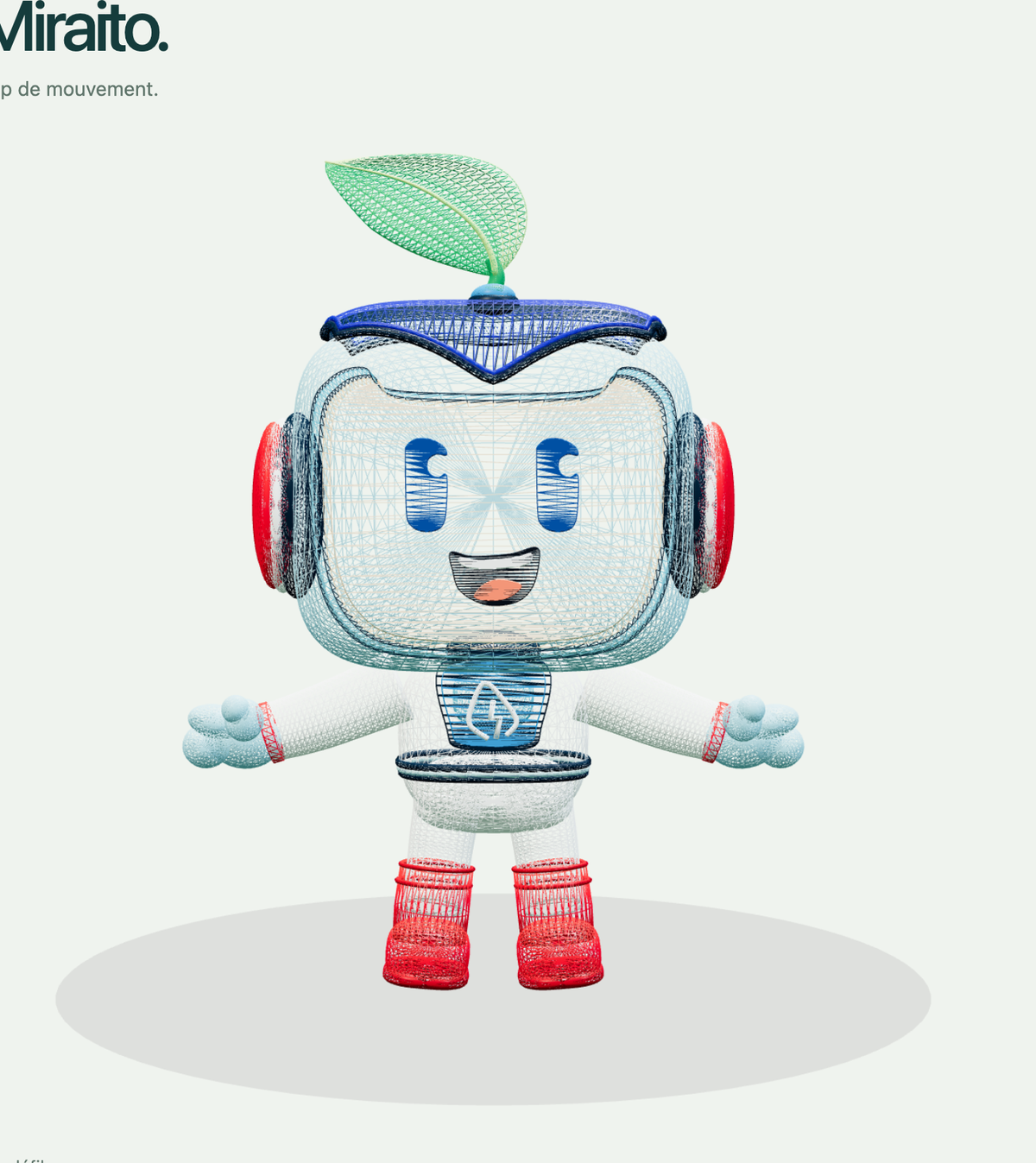
52,980 Triangles and Not One Texture
Here is the thing I most want to point at, because it is the least obvious decision in the whole build.
The finished model is 52,980 triangles, weighs 2.5 MB as a GLB, and uses one material and zero textures.
Zero. No UV unwrapping, no texture bakes, no 4K colour maps. Every colour on that character — the blue helmet, the cream face, the red boots — is geometry and material, not a painted image stretched over geometry.
That choice pays you back three times:
The trade-off is honest: this only works for a stylised character. If your mascot has fur, fabric weave, or printed patterns, it needs textures and the file gets heavier. Miraito is made of smooth plastic shapes, so geometry wins.
33 Bones, and 8 of Them Do the Thinking
Under the surface is a skeleton — 33 bones — plus 8 IK controls in Blender.
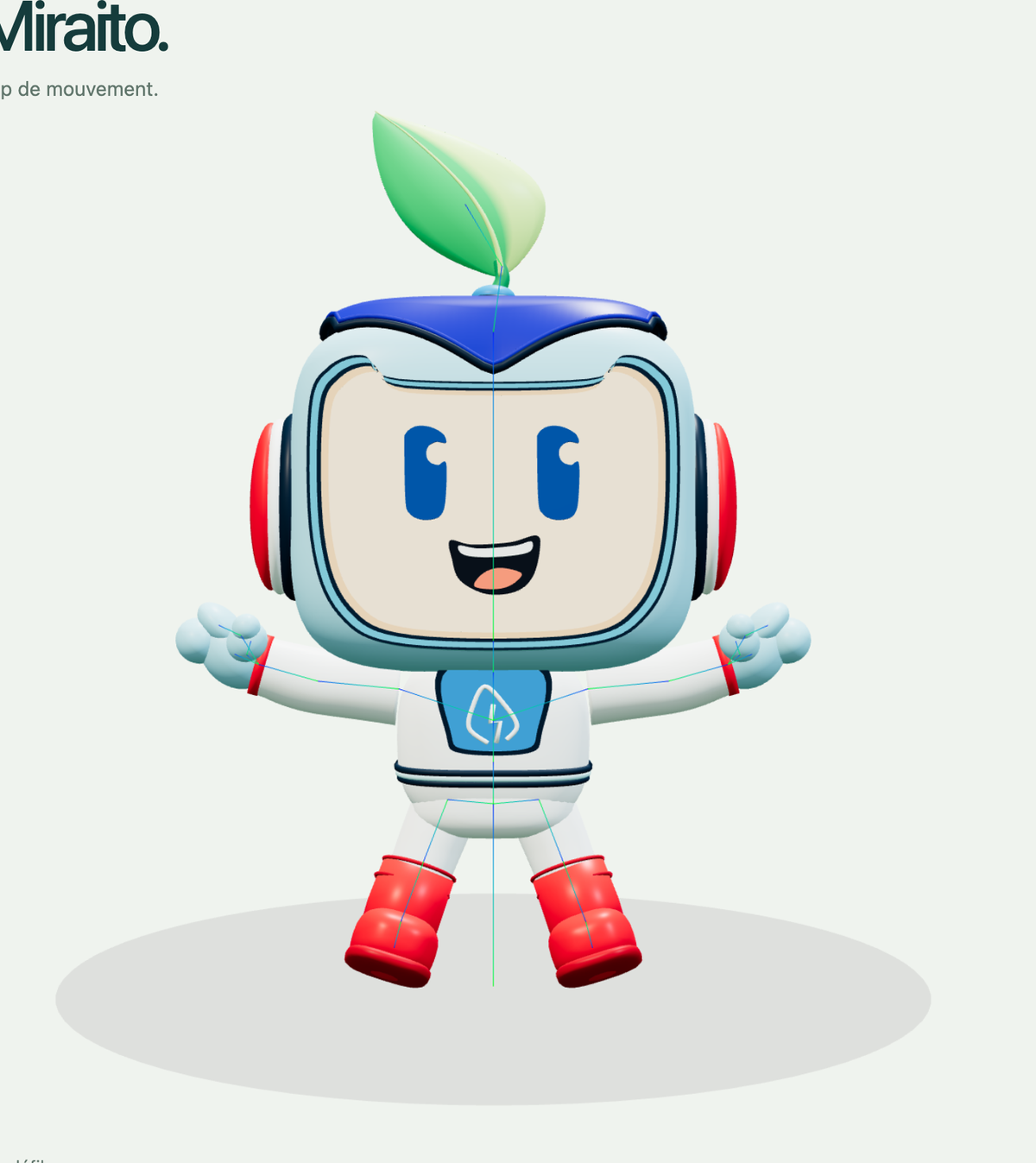
The bone count is unremarkable. The IK controls are the part that matters, and they are the difference between a rig an animator enjoys and a rig an animator quietly resents.
Without IK, posing a foot means rotating the hip, then the knee, then the ankle, and repeating until it looks less wrong. With IK you grab the foot, put it where the foot goes, and the leg works itself out. Same for hands. Eight controls: two feet, two hands, and the chain targets that keep elbows and knees bending the right way instead of snapping inside out like a folding chair.
You feel this in the cost of revisions. "Can he wave a bit higher?" should be a five-minute change, not a re-animation.
The Face Is Four Numbers
The expressions are not bones at all. They are morph targets — sculpted variations of the mesh that the renderer blends between, each driven by one value from 0 to 1.
Miraito has four: left eye, right eye, smile, surprise.
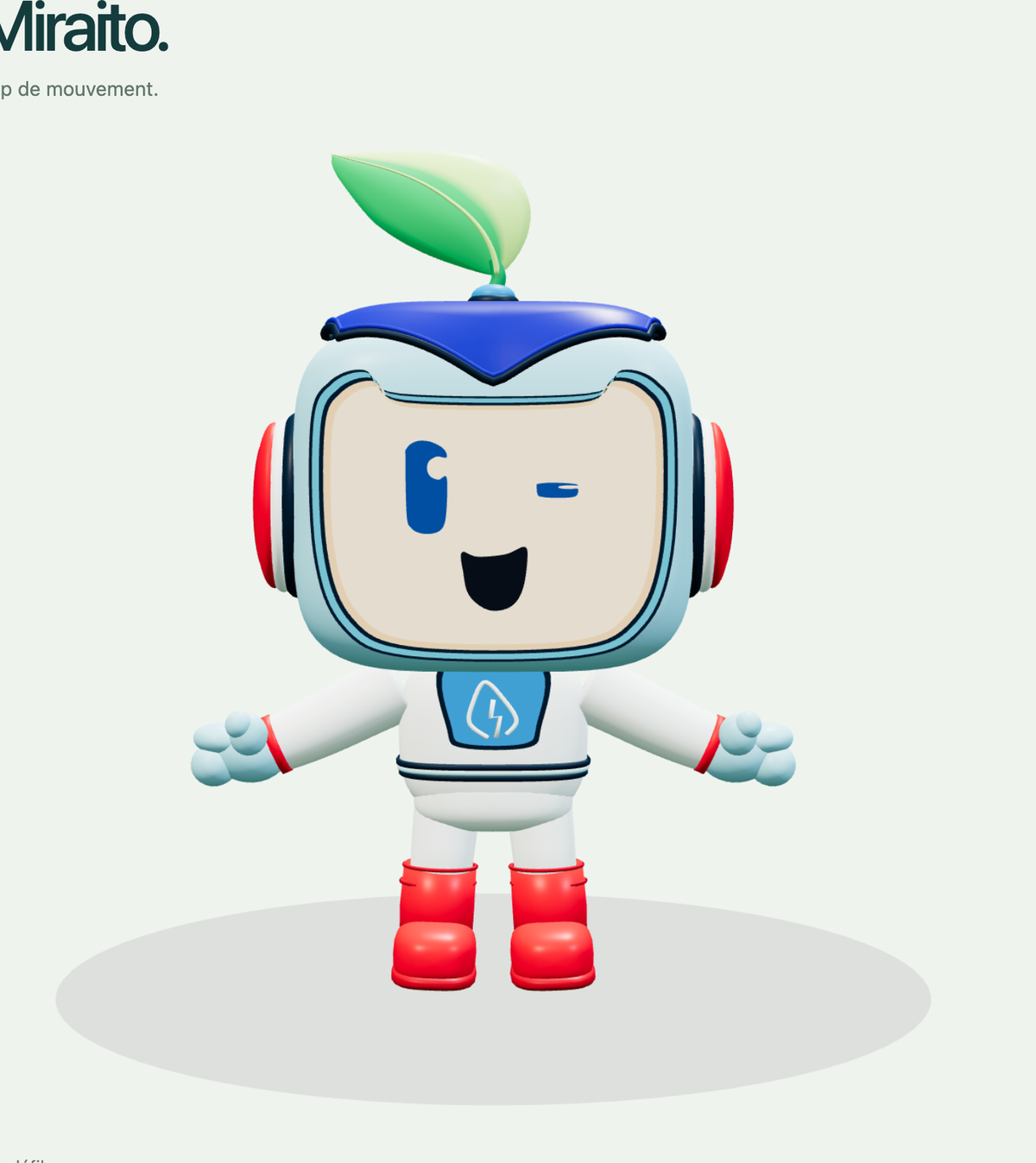
Four numbers sounds thin until you notice they blend. Half a smile with a full surprise is a different face from either one. Separate eye controls mean winks, and mean the auto-blink can run continuously underneath whatever else is happening without fighting it. Every combination is a valid face, which is exactly what you want when a character has to react to events you have not scripted yet.
A face built this way is also trivially controllable from code. Player wins the game? Push smile to 1 over 200 milliseconds. No animator needed at runtime.
Five Animations Is a Whole Personality
The character ships with five loops: idle, walk, wave, celebrate, point.
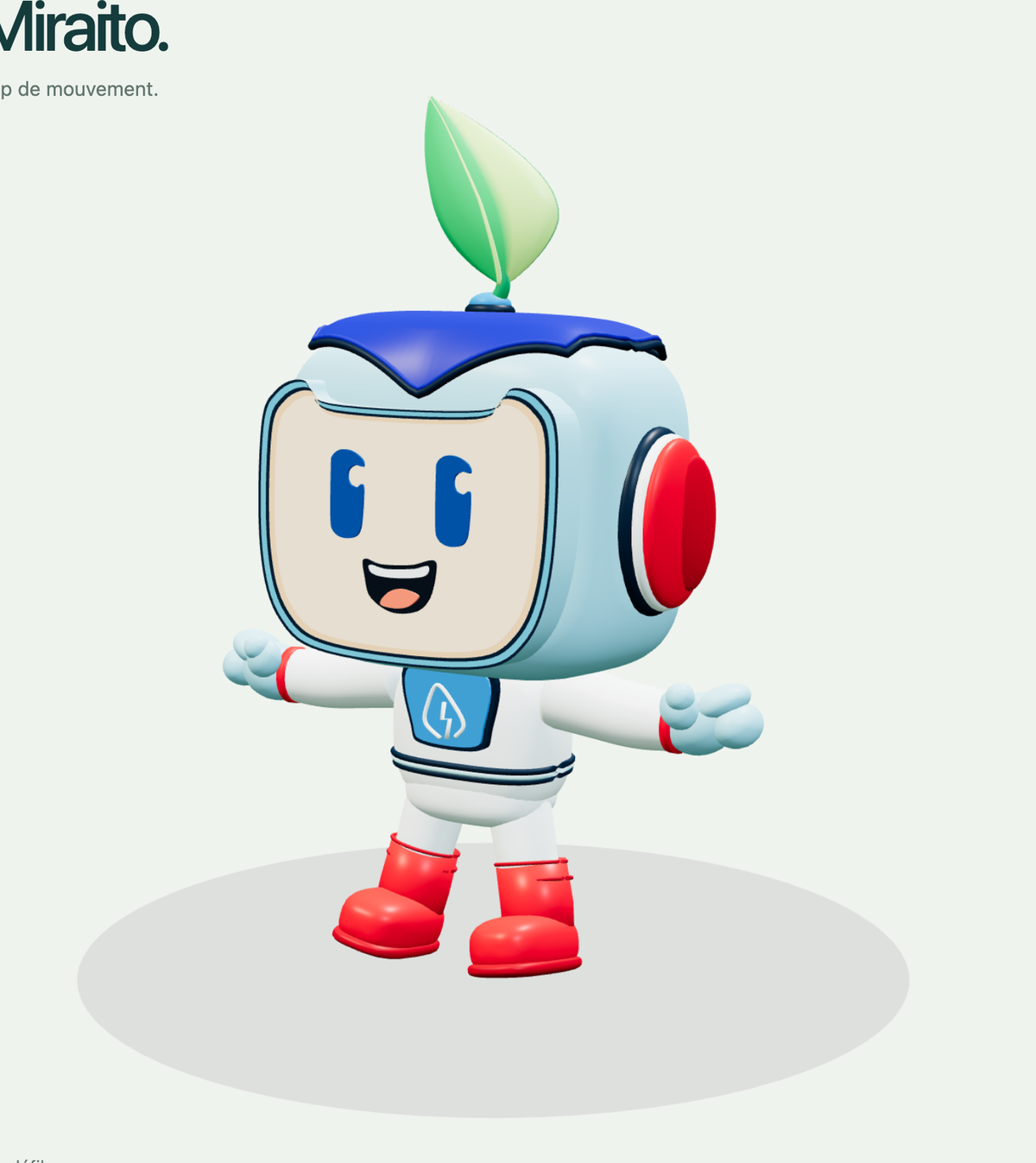
If you only ever budget for one, budget for idle. It is the animation nobody asks for in a brief and the one that runs 95% of the time. A character standing perfectly still reads as broken — as an image that failed to load. A character breathing, shifting weight, letting the leaf bob slightly reads as alive, and that impression is doing more work for your brand than the wave ever will.
The other four are the vocabulary of an interface. Walk for transitions. Wave for arrival. Celebrate for success. Point for "look here, tap this." That is nearly every moment in a campaign flow where a host character has something to say.
The Part That Actually Gets It Approved
A rig nobody can inspect is a rig nobody can sign off. So the model does not arrive as a video or a turntable GIF — it arrives as the tool you have been playing with at the top of this article.
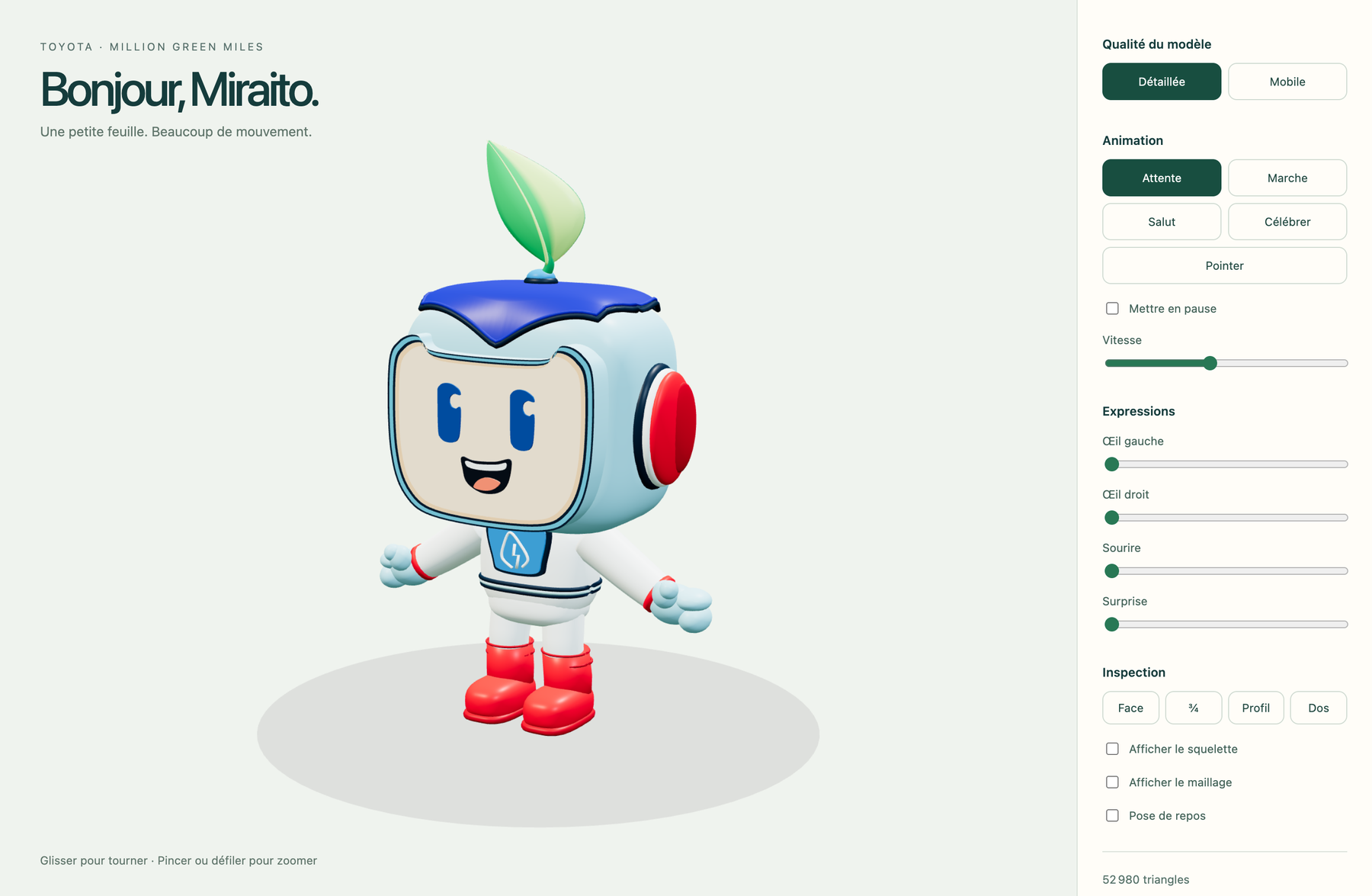
What is in there, and why each thing is in there:
None of this is glamorous. All of it removes a round of email.
Then It Has to Live Somewhere Real
A character in a viewer is a character in a vacuum. Here is the same model, same GLB, dropped into a campaign landing page — greeting you by name, standing on a podium, with the mascot controls kept behind a review panel so the client can still poke at the motion without that scaffolding shipping to the public.
The campaign this belongs to also has a 3D map of Vietnam you can fly through, which is the other half of the same pitch. Mascot greets you, map shows you what everyone has done together.
What We Need From You, and What We Will Not Do
Fair warning about how this goes:
What helps. Reference art from as many angles as exist — even rough turnarounds. The brand guide. Any existing 3D. If the character has ever been made as a plush toy or a costume, send photos of that, because somebody already solved the "what does the back look like" problem.
What we ask about. Most licensed characters come with usage rules, and a 3D reconstruction sits in an awkward spot next to a clause that says "do not redraw". So our build goes to the brand team as a proposal for review, not as a fait accompli, and flat placements in decks use the official artwork rather than our version of it.
What this is not. It is not a film rig. There is no facial bone system, no cloth simulation, no muscle deformation. It is a real-time character built to hold up at 60fps on a phone in a browser, and a lot of the craft is knowing precisely what to leave out.
What it does not fix. If the character does not work as a design, 3D will make that louder, not quieter. We have never seen dimension rescue a weak mascot.
Send Us Your Mascot
If you have a character living in a PDF, it is probably capable of more than it is currently being asked to do.
We model in Blender, ship glTF, and the whole thing goes through the same pipeline as everything else we pitch. See more of the studio's 3D work, or the branded games these characters usually end up hosting.
Or just send us the art and we will tell you what it would take to make it wave.
Miraito is a mascot owned by Toyota. The 3D reconstruction shown here was designed and built by Code Crush as a concept for a Toyota Vietnam campaign pitch, reviewed as a proposal rather than as final brand-approved artwork.
Tagged with


